My thoughts drifted back to the present. The building of Old Mission Dam may not be very impressive by today's standards. But it becomes impressive when you realize that every stone was carried and put into place by hand, all the clay tiles were made by hand, and that the dam was built entirely without the use of modern machinery or technology under very difficult conditions. Damaged and no longer in use by 1831, partially repaired in the late 1800's and again in the 1930's, Old Mission Dam has stood for nearly 200 years. It has endured many severe floods while some of the construction of this century has collapsed. During floods in the early 20th century, the San Diego River flowed as high as 12 feet above the top of the dam.
Unfortunately, much of the history of Old Mission Dam is still a mystery and has generated conflicting speculation among historians. Known records are scarce and often vague. Reports vary on many details and many questions are left without definitive answers. When did construction begin? What did the dam look like when it was operational? Was there another dam built down river before this one? Did the flume end above the mission, as some reports indicate, or below it? There are many more questions that as yet remain unanswered.
I was curious that some early observations had noted remnants of the flume existing behind and above the Mission San Diego compound. This would have been most practical and convenient. Otherwise, if the flume ended somewhere nearby but in the river valley below, water would have to be raised over 50 feet to the elevation of the mission buildings. A close study of the California Division of Mines and Geology map proved that the flume could not have ended above the mission as stated in these observations. Upon exiting Mission Gorge, the flume elevation is already below that of the Mission site which is over 2 miles away and approximately 130' above sea level. An aqueduct could have existed above the mission, but water still had to be raised somehow from the river valley.
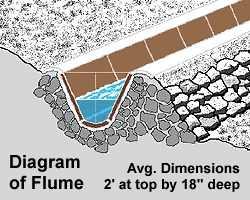
I stood on the longer north end of the dam close to the wide opening where the San Diego River passes through. On the many occasions I had come to Old Mission Dam, I didn't understand or appreciate what I saw until recently. As simple a structure as this is, it isn't easy to visualize how it worked because it is no longer intact. The 12 foot wide rectangular opening below me once contained a floodgate, probably wooden, that could be used to control the level of the reservoir. The reduced height of the dam on the south side of the river was a recent partial restoration of the damaged portion of the dam. Originally, the dam was the same height all the way across the river so as to create a reservoir. Across from me, the second of two walls forming a "V" shape functioned as a buttress. The missionaries added it later to reinforce this part of the dam. The outlet that supplied water to the flume is an inconspicuous tile pipe with an inside diameter of only 3 ½ inches. It is visible at the north end and about 4 feet from the top of the dam. Water from this outlet poured into a capture zone, powered a water wheel which operated a grist mill, then emptied into the flume for the 5 ½ mile journey to the mission.
As I made my way back across the dam's uneven surface, I still felt a sense of the past, of the people's lives that created the dam, maybe even of their thoughts. I realized that rather than just writing a dry chronology thick with facts and speculation, I wanted to share the presence of history and the sense of mystery felt here. To me, Old Mission Dam is, in a way, a lasting monument to those who built it.
by Bill White '97
* * *
|


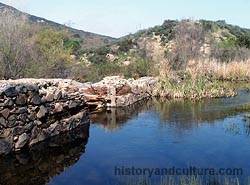 Yesterday morning, I was standing on the thick wall of boulders, cement and tile that make up Old Mission Dam and reflecting on the scene around me. This is a very peaceful and beautiful site on the San Diego River. The air is still and slightly cool. Songbirds call from the trees and chaparral, mixed with the occasional quack of mallards. In the background is the river's lulling murmur as it spills through the aged dam's open gate. The river has slowed now, sounding only a little louder than a fountain. Voices float from a trail beyond the trees. Across the river, a pair of bicycles coast by on the roadway that used to be Mission Gorge Road. The sky is a soft and cloudy grey, typical of a June morning.