|
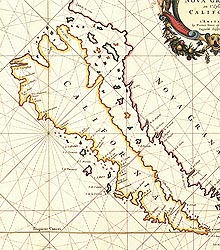
Some early explorers of the
1600's believed California to be an island.
|
Early Explorers 1542 - 1769
Competition for wealth and power among European nations was
largely dependent on lucrative trade with Asia. Established
trade routes through the Mediterranean and across continental
Asia were long and costly and no sea route had been established
yet around Africa. Based on a risky theory that the world
was round, Christopher Columbus sailed West hoping to discover
a shorter and faster route to Asian trade centers, instead he
found the new world. After European discovery of
the Americas, there was a rush to claim territory and resources
in the new world during the 16TH century. Spain became
the most powerful European nation as it plundered a wealth of
gold and other treasures from the Indian civilizations of Mexico
and South America. Spain continued its exploration and
set up a Pacific trade route to Asia that was based in the Philippines.
1542 Juan Rodriguez Cabrillo
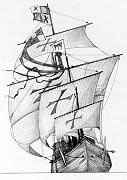 Juan
Rodriguez Cabrillo, sailing for the Spanish crown, left Mexico
to explore the coast of California. He was in search of
the Northwest Passage, a route which, if it existed, would let
ships pass from the Atlantic to the Pacific en route to the Spice
Islands without having to round the tip of South America. On
September 28, 1542, after 103 days voyage, Cabrillo and his crew
found refuge in a harbor he named San Miguel, later renamed San
Diego. He continued up the coast, claiming western North
America for Spain and naming it California. Juan
Rodriguez Cabrillo, sailing for the Spanish crown, left Mexico
to explore the coast of California. He was in search of
the Northwest Passage, a route which, if it existed, would let
ships pass from the Atlantic to the Pacific en route to the Spice
Islands without having to round the tip of South America. On
September 28, 1542, after 103 days voyage, Cabrillo and his crew
found refuge in a harbor he named San Miguel, later renamed San
Diego. He continued up the coast, claiming western North
America for Spain and naming it California.
Later in the 16th century, English sailing vessels also explored
the California coast. Spain needed a resting place for
her Manila galleons sailing from the Philippines to Acapulco,
and needed to strengthen its territorial claim before England
or Russia could establish colonies in California.
1602 Sebastian Vizcaino
Sixty years after Cabrillo's voyage, the Spanish government
sent Sebastian Vizcaino to explore California's coast following
Cabrillo's maps. Vizcaino anchored off Point Loma
on November 10, 1602. In honor of the saint, San Diego
de Alcala and Vizcaino's flagship San Diego, he renamed the bay.
Viscaino continued north as far as Monterey, and upon discovering
Monterey Bay, described it as an ideal location for a Spanish
port.
For the next 167 years the inroads made by Cabrillo and Vizcaino
remained unexplored while Spanish trade galleons, enroute from
the Philippine Islands to the port of Acapulco, continued to
travel in sight of the California coast.
1769 Gaspar de Portola & Fr Junipero
Serra Expedition
Attention returned to the territory when Russian fur traders,
already established in Alaska, were moving south into California.
In 1768, King Carlos III of Spain finally issued an order to
occupy California. He appointed Jose de Galvez in Mexico
to organize an expedition to colonize California, beginning with
the strategic bays of San Diego and more importantly, Monterey.
Based on Vizcaino's maps and writings from over a century before,
Monterey Bay was selected as the primary goal for the expedition,
having been described as an excellent harbor, and well located
along the California coast. Gaspar de Portola volunteered
to command the expedition and was made acting military governor
of California, Father Junipero Serra was chosen to lead the missionary
effort. The plan was to combine both land and sea expeditions
which would rendezvous at the harbor in San Diego, establish
a settlement, then continue north to find Monterey.
The huge harbor at San Francisco had not yet been discovered.
Portola & Fr. Serra Expedition by Sea
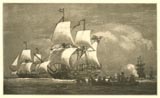 Early in 1769, two supply ships
were prepared with provisions and men at the Spanish port of
La Paz, in Baja California. The San Antonio was first to
depart La Paz for San Diego harbor on Jan.10th. The San Carlos
followed a month later, on Feb. 15th. Each ship was blessed
before setting sail by the religious leader of this expedition,
Father Junipero Serra. He would travel overland up the
Baja peninsula with the military commander Portola and
meet the ships in San Diego. Another ship was built for this
expedition at the port of San Blas on the west coast of Mexico.
This ship, the San Jose, was to arrive in Monterey later with
supplies to replenish the expedition. Early in 1769, two supply ships
were prepared with provisions and men at the Spanish port of
La Paz, in Baja California. The San Antonio was first to
depart La Paz for San Diego harbor on Jan.10th. The San Carlos
followed a month later, on Feb. 15th. Each ship was blessed
before setting sail by the religious leader of this expedition,
Father Junipero Serra. He would travel overland up the
Baja peninsula with the military commander Portola and
meet the ships in San Diego. Another ship was built for this
expedition at the port of San Blas on the west coast of Mexico.
This ship, the San Jose, was to arrive in Monterey later with
supplies to replenish the expedition.
After 55 days voyage, the San Carlos arrived in San Diego
on April 11. It was the second ship to leave La Paz.
Many were sick from scurvy and the San Antonio, which should
have been first to anchor, was nowhere in sight ... they anchored
and waited on board without leaving the ship. Finally,
two weeks later the San Antonio entered the bay, even though
it had sailed from La Paz a month earlier than the San Carlos.
After a grueling 110 days voyage, 24 on board were dead from
scurvy, and the remaining sailors too sick to lower a land boat.
The sea expedition made a tent camp on the beach, found fresh
water, and tended the sick. Men were dying every day as
they waited in the harbor for 3 more weeks until the first land
expedition arrived. The last ship, the San Jose,
had been sent to Monterey to resupply the expedition. It
was lost at sea.
Portola & Fr. Serra Expedition by Land
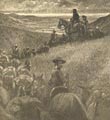 The two land expeditions
gathered near Santa Maria, the northernmost mission in Baja California,
and still more than 200 miles south of San Diego. After
a 50 day journey, Father Juan Crespi and Captain Fernando Rivera
arrived in San Diego on May 14 with the first 42 members of the
land expedition. Captain Rivera relocated the beach camp
created by the ship crews to a hill near the river.
This was the site where the presidio was later built. The two land expeditions
gathered near Santa Maria, the northernmost mission in Baja California,
and still more than 200 miles south of San Diego. After
a 50 day journey, Father Juan Crespi and Captain Fernando Rivera
arrived in San Diego on May 14 with the first 42 members of the
land expedition. Captain Rivera relocated the beach camp
created by the ship crews to a hill near the river.
This was the site where the presidio was later built.
The leader of the expedition, Gaspar de Portola, arrived
June 27, two days in advance of Father Junipero Serra.
Serra's party included the remainder of the 70 man land
expedition, along with herds of various livestock, horses, and
163 pack mules carrying supplies.
1769 San Diego Mission Founded
At presidio hill, Father Serra dedicated the first mission
in Alta California on July 16, 1769. Just two days before
the ceremony, Portola headed north to find Monterey Bay.
He left behind a settlement of 40 with Fr. Serra and ordered
the San Antonio back to San Blas for supplies, leaving the San
Carlos at anchor for lack of adequate crew.
Portola's expedition to Monterey lasted nearly 9 months.
Unable to locate Monterey Bay and thinking it farther north,
the 60 man expedition came upon another bay so large that Fray
Juan Crespi wrote, "doubtless not only all the navies of
our Catholic Monarch, but those of all Europe might lie within
the harbor." From then on, San Francisco entered into
Spanish plans for expansion.
Meanwhile, in San Diego the Kumeyaay Indians had largely ignored Serra's missionary efforts and were cautious about the small Spanish camp where so many men were ill. By the time Portola returned to San Diego, only twenty of the 40 men left at the camp had survived the ravages of scurvy. Although Junipero Serra insisted the expedition must remain no matter what, Portola set a deadline of March 20. If supplies did not arrive by that time, San Diego must be abandoned. On March 19, there were cheers as the fully provisioned San Antonio appeared on the horizon.
~
by Kathy Hughart & Bill White 1999
|